Pinocchio guards the henhouse and exposes the Weasels
The Adventures of PinocchioPinocchio guards the henhouse and exposes the Weasels is an episode in which a punishment imposed after a hungry mistake becomes an unexpected test of character. Pinocchio is caught taking grapes, chained as a replacement watchdog, and tempted by thieves who expect him to follow the example of his predecessor. Instead, he helps Farmer John capture them, and the farmer frees him. The shift from confinement to liberty rests not on escape or force but on Pinocchio’s refusal to be bribed.
From Hunger to Captivity
On his way toward the Fairy’s house, Pinocchio’s hunger grows difficult to endure. He jumps into a field for a few grapes, but a trap snaps shut around his legs. The trap had been set by a farmer for Weasels that came nightly to steal chickens. Pinocchio’s attempt to satisfy his hunger thus places him in the very device meant to catch the henhouse thieves; the resemblance between his trespass and theirs is immediate, though their purposes and actions are not identical.
Farmer John approaches on tiptoe, hoping to find the Weasels, and is astonished to discover a boy in the trap. Pinocchio protests that he came only for grapes. The farmer treats the theft as grounds for suspicion, reasoning that someone who steals grapes could also steal chickens, and carries him by the collar to the yard. There he throws Pinocchio down, puts a foot on his neck, and assigns him to replace the watchdog who died that day.
The punishment is made physical and difficult to evade. Farmer John slips a dog collar around Pinocchio’s neck, fastens it tightly, and attaches a long iron chain whose other end is nailed to the wall. Pinocchio is told that if it rains he can sleep in the nearby doghouse, where the dead watchdog Melampo had slept for three years. His former freedom to travel toward the Fairy’s house has been reduced to the reach of a chain, and his immediate task is to guard the very chickens whose theft brought the Weasels and the trap into the story.
The Weasels’ Offer
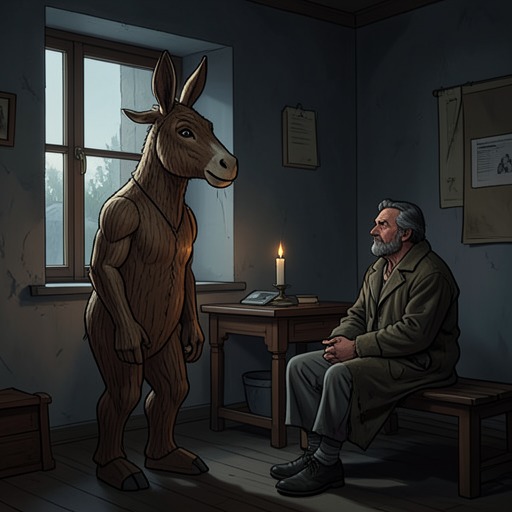
Pinocchio falls asleep in the doghouse despite his unhappiness. Near midnight, whispering and stealthy sounds wake him. He sees four Weasels in the yard; one approaches the doghouse and addresses him as Melampo. The greeting assumes a continuity between the dead watchdog and his replacement, and the bargain that follows makes that assumption explicit.
The Weasel proposes that the group continue visiting the henhouse as before. They will take eight chickens: seven for themselves and one for Pinocchio, provided he pretends to sleep and does not bark to alert Farmer John. The offered chicken is a direct temptation to a hungry captive, while the appeal to the old arrangement gives the proposed betrayal the appearance of an established routine. Pinocchio asks whether Melampo really accepted those terms. The Weasel confirms that he did, describing the two as good friends and promising Pinocchio a chicken for breakfast.
Pinocchio appears to accept the offer, but his response is a ruse. Once the four Weasels have agreed on their plan, they go to the nearby chicken coop and use their teeth and claws to open its little door. As soon as they are inside, Pinocchio shuts the door and drags a heavy stone in front of it. His confinement has not given him control over the yard, but within the narrow opportunity presented by the thieves’ trust, he acts decisively.
Exposure and Release
Having barred the Weasels inside, Pinocchio barks loudly, imitating a real watchdog. Farmer John hears him, takes his gun, goes to the window, and asks what is happening. Pinocchio answers that the thieves have arrived. The alert converts the role imposed on him into an effective one: although chained in place and initially treated as a suspected thief, he is now the person who exposes the robbery.
Farmer John hurries to the coop, opens it, and pulls the Weasels out one by one. He ties them in a bag and tells them he will take them to the inn in the morning, where they will become dinner for a hungry person. The threat is a pointed reversal: the animals who intended to steal food are themselves to be made into food. Farmer John then pets Pinocchio and contrasts his discovery of the thieves with Melampo’s failure to see them over the years.
Asked whether he was awake when the Weasels came, Pinocchio says he had been asleep until their whispering woke him. He reports that one offered him a chicken if he would not bark, and explains that he refused to be bribed, despite being a marionette with many faults. Farmer John praises him and declares him free immediately, then removes the dog collar from his neck. The release is concrete and prompt: the chain that had fixed Pinocchio to the wall is no longer attached to him.
The Episode’s Moral and Narrative Turn
The event reverses the consequences of Pinocchio’s earlier act without erasing it. His hunger led him to take grapes, and Farmer John’s suspicion and harsh punishment followed; later, when hunger is again invoked as an incentive, Pinocchio does not use it to excuse taking what belongs to someone else. The Weasels’ offer gives him an opportunity to betray the farmer in return for food, but he instead protects the henhouse and tells the truth about the attempted bribe.
The contrast with Melampo gives the episode an additional moral turn. The Weasels present the previous watchdog’s complicity as a precedent and a friendship, but Pinocchio does not inherit that arrangement with the collar. His first successful act in the role is to reject the bargain and expose the thieves. The episode therefore makes faithfulness visible through actions—the closed coop door, the stone dragged into place, the barking, and the report to Farmer John—rather than through a promise alone.
In the surrounding sequence, the episode follows Pinocchio’s journey toward the Fairy’s house and his earlier dismissal of the Talking Cricket’s advice. Its outcome is not a permanent transformation or a reward detached from circumstance: Pinocchio is freed because he performs the task he was forced to undertake and refuses the thieves’ payment. The chapter’s turn from a trapped trespasser to a trusted guard makes the episode a compact demonstration of how an imposed duty can become an occasion to act differently.